
TESTIMONIALS:
- “It helped me understand grammar structure better, and I can tell stories to my sister so we learn together.”
- “Watching students naturally transition from reading to writing, and then taking the initiative to share the stories at home with siblings and parents, demonstrates how effectively this format builds both confidence and comprehension.”
- “It’s entertaining and easy to understand. It builds our vocabulary while leaving a meaningful message: that everyone matters.”
Spanish-English Language Learning Book
Give the Gift of Language. Open the Door to a Brighter Future.
“This book has both structural and cross-teaching symmetry to make the learning process easier.”
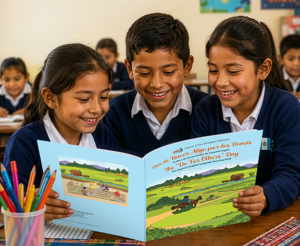
The Critter Adventure Tales Spanish-English Language Learning Book is generating strong enthusiasm among teachers, parents, and students in Guatemala City and surrounding communities.
Early educators and school administrators are recognizing the book’s unique ability to make English learning engaging while also helping students understand the similarities and differences between Spanish and English.
Teachers are especially excited about the book’s visual storytelling approach, which supports vocabulary development, reading comprehension, and greater student independence. The bilingual format also gives teachers a practical way to help students compare sentence structure, grammar, and word order between the two languages in real time.
Interest extends beyond the classroom. Parents see the books as an engaging resource that encourages children to practice English at home while reinforcing the Spanish language they already know. Students are responding enthusiastically to the colorful characters and adventure-based stories, making language practice feel less like traditional coursework and more like an experience they want to participate in.
Benefits for Children
Enhanced Literacy and Language Skills: Storybook reading, with repeated exposure to new vocabulary (as in this book’s color-coded words and glossary), effectively supports receptive word-learning and vocabulary growth in young children. This approach to bilingual learning strengthens literacy in both a student’s primary and secondary languages.
Cognitive Development and Executive Function: Bilingualism improves cognitive flexibility, problem-solving, inhibitory control, multitasking, and focus. Bilingual children often outperform monolinguals in tasks requiring attention switching and logical thinking.
Academic Advantages: Long-term bilingual education correlates with higher standardized test scores, better reading comprehension, and stronger overall academic performance.
Social-Emotional Growth and Confidence: Access to bilingual resources helps children maintain cultural and family connections, while building communication and academic confidence through successful language practice. Engaging stories with adorable characters foster excitement, emotional regulation, and social skills. Teachers and parents report improved comprehension and enthusiasm, with students eager to continue learning at home.
Long-Term Opportunities: Early bilingual exposure prepares children for a globalized world, enhancing cultural awareness and future opportunities.
Benefits for Adults
Brain Health and Cognitive Protection: Learning or supporting a second language as an adult strengthens memory (including episodic memory), attention, concentration, and mental flexibility. It can delay cognitive decline and onset of dementia symptoms.
Career and Practical Advantages: Bilingual skills improve employability, earning potential (multilingual workers often earn more), and opportunities in diverse settings. They also enhance problem-solving, creativity, and multitasking relevant to professional and daily life.
Family and Intergenerational Benefits: Parents using this book alongside their children helps to strengthen family bonds, model lifelong learning, and support bilingual development in their young learners… while improving their own Spanish-English proficiency and cultural connections.
Personal Fulfillment: Language learning boosts listening skills, self-confidence, and overall mental well-being through engaging, low-pressure activities like shared reading.
This book serves as a bridge for family learning, extending classroom gains into the home and fostering shared confidence and connection.
The enthusiasm has already helped create opportunities for broader implementation. A pilot project is being developed with Colegio Boston Bilingual, involving teachers, administrators, and students, with additional coordination underway in Salamá, Baja Verapaz, where the program could reach approximately 70 students and staff. The goal is to collect meaningful feedback and measurable results while integrating the books into existing English instruction without disrupting the curriculum.
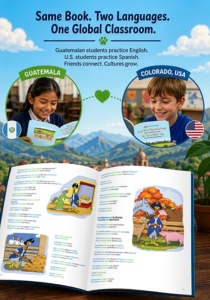
Perhaps most exciting is the potential for a “Sister Schools” international learning experience, connecting Guatemalan students with students in the United States. Through pen-pal or text-pal exchanges, students could communicate with one another using the very same Critter Adventure Tales books—Guatemalan students practicing English while their U.S. counterparts practice Spanish.
The response from educators, families, and students demonstrates that Critter Adventure Tales has the potential to become more than a language-learning book. It can serve as a bridge between languages, classrooms, families, and cultures—creating an engaging, interactive way for children in Guatemala and the United States to learn from one another while building real-world language skills.